
Lattice boom crawler cranes
Filters
Show filters


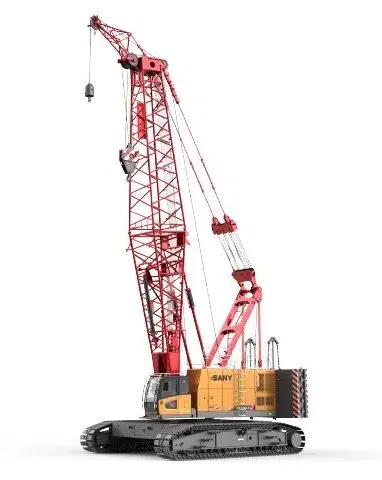
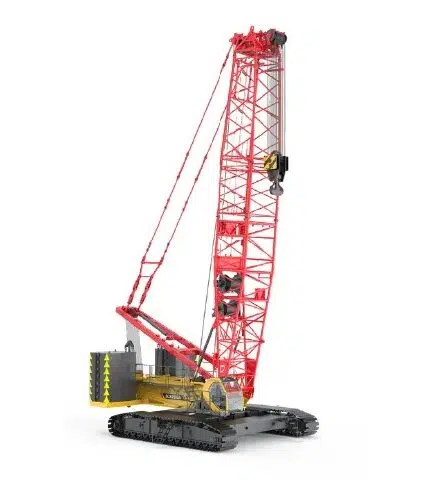

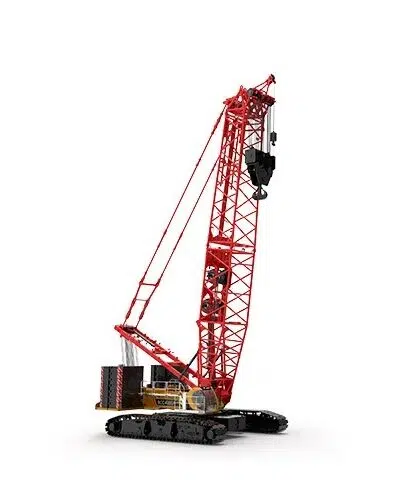


How do we define a lattice boom crawler crane?
The main arm makes all the difference. Instead of a solid box girder, its structure uses interlocking metal profiles in a mesh pattern. This technical choice significantly lightens the boom while dramatically increasing its resistance to torsion and bending.
Forget hydraulic deployment. The lattice boom crane is assembled directly on-site using bolted or pinned sections. This design allows for unprecedented lengths. The base rests on massive crawler tracks. These distribute the machine's weight over a large ground area, making the use of lateral stabilizers completely unnecessary.
Why choose a lattice boom over a telescopic model?
Maximum lifting capacity over a long span
The openwork design lightens the boom. All the machine's power is therefore concentrated on the payload. Over long distances, performance remains exceptional. Telescopic versions often suffer from the weight of their own steel sections. This structural lightness of the lattice boom allows heavy elements to be lifted far from the machine's center of gravity, a major advantage when a direct approach is impossible.
Stability on soft or sloping ground
The tracks minimize ground pressure. Working on difficult or muddy terrain? Where tires would sink, the undercarriage ensures perfect stability. The machine can even move with its load suspended. This renowned pick-and-carry function completely revolutionizes site logistics by reducing the need for transfers between multiple machines.
Controlled operating costs
Admittedly, the initial assembly takes time and sometimes requires additional machinery. However, the long-term performance more than compensates for this investment. The mechanical simplicity of the lattice reduces complex hydraulic breakdowns. Regular maintenance becomes less demanding, which lowers maintenance costs and maximizes uptime on extended missions.
| Evaluation criteria | Lattice Arrow | Telescopic boom |
| Facility | Floor assembly | Rapid hydraulic deployment |
| Holding capacity | Excellent for long distances | Loss of capacity due to the weight of the arm |
| Site visit | Possible with the load | Static on deployed stabilizers |
Key areas of application and sectors
These giant machines are designed for large-scale projects. In the energy sector, installing wind turbines requires an exceptional reach to lift aerial work platform and blades to heights of over one hundred meters. The machine then remains on site for several weeks to assemble the entire wind farm.
For bridges and viaducts, concrete blocks weighing several tens of tons must be positioned. Since riverbanks are rarely stable, tracks become essential. The industrial sector also makes extensive use of this technology to install tanks and reactors. During recent port expansions, operators used these cranes to move marine blocks. They took advantage of the slow movement along the quayside for millimeter-precise adjustments.
Our range of lattice boom crawler cranes
At SNM CRANES, we distribute robust machines from global manufacturers such as SANY and Terex. Each model meets specific lifting requirements, from tight urban construction sites to massive infrastructure projects.
Compact Range
Capacity: 80 to 150 tonnes
Features: Small footprint, simplified assembly, easy road transport of components.
Perfect for special foundations and conventional civil construction.
Heavy Duty Range
Capacity: 250 to over 600 tonnes
Features: Multiple configurations, derrick, superlift, maximum hook height.
Designed for energy infrastructure and the handling of heavy industrial packages.
Do your constraints require immediate setup for a short period? Consult our dedicated section to discover our range of telescopic booms.
How to choose the right equipment?
The actual load capacity
The net weight of the workpiece isn't everything. You must also factor in the mass of the lifting accessories, such as blocks, spreaders, and slings. Consult the manufacturer's load charts to verify the lifting capacity at the intended working radius. The raw force advertised by manufacturers often corresponds to lifting very close to the axis, a situation that is actually quite rare in practice.
The useful height and reach
The horizontal distance between the axis of rotation and the landing point determines the required clearance. Remember to anticipate any obstacles in the area. Adding a variable-length boom provides extra articulation at the mast end. This is invaluable for flying over buildings or dropping loads onto a roof with absolute precision.
The nature of the terrain
Carefully analyze the ground bearing capacity. Tracks reduce pressure, but marshy areas or recently created embankments sometimes require prior preparation. Also, ensure sufficient ground space. Assembling dozens of meters of latticework requires a completely clear corridor before the mast can be raised.
Purchase, rental or second-hand, which strategy to adopt?
Investing in new equipment gives you access to the latest technological and safety advancements. It's the most logical solution for intensive, long-term use.
For a one-off need or a specific market, leasing proves to be much more flexible. You preserve your cash flow while operating a serviced and ready-to-use machine. SNM CRANES also offers long-term leasing contracts perfectly tailored to the pace of your work.
Looking to control your purchase budget? Our used models are an excellent alternative. Our workshops fully service each machine before it is put back on sale to guarantee immediate operational reliability.
A complex lifting operation demands meticulous planning. The chosen machine dictates the pace of the work and ensures the safety of the teams. Faced with harsh environments and extreme loads, crawler cranes with mesh booms provide a formidable mechanical solution. The experts at SNM CRANES are here to analyze your load plans and define the exact configuration you need.